Saturday, November 16, 2024

Geoscience Internships

Geoscience internship programs are an increasingly popular way to get field and/or research experience, and sometimes to meet culminating experience requirements in Bachelor of Science degree programs. These internships are often in the summer and you should be a (rising) senior geoscience student. Here is a list of internships :

Undergraduate student internship opportunities

NAGT/USGS Cooperative Summer Fellowship Program'

List of internships from the Institute for Broadening Participation

GSA Planetary Geology Division student opportunities

Graduate student internship opportunities

National Science Foundation / USGS Internship Opportunities

I will continue to add internship opportunities to this page as I discover them...

Jobs in the Geosciences

I am compiling a list of non-academic jobs in the geosciences as a resource for students in the School of the Environment at SF State. Narrow the geographic location for your search, and use keywords like "GIS", etc. 

Association of American State Geologists Employment Opportunities span a wide range of sub-fields in geology for entry-level to senior-level geologist positions, and including student opportunities, all over the country. A sampling of positions in 2023 includes museum scientists across a broad range of specialties, engineering geologists including seismic hazards and burned watershed engineering, geospatial specialists including GIS, natural hazard mitigation, coastal geologists, instrumentation technicians, natural resource scientists, geologic mapping specialists including map standards, including digital mapping, geochemists, program chiefs,  subsurface geoscientists, carbon sequestration seismologists, environmental analysts, marine geologists, oceanographers, remote sensing scientists, communication & outreach specialists, hydrogeologists, field geologists, media production specialists, geologist-in-training, etc.)

LinkedIn gives a wide array of geoscience jobs in the San Francisco Bay Area

ZipRecruiter returned several two dozen results when I searched for a "Geologist" position in/near San Francisco, California.

Indeed.com had a different selection of jobs in the San Francisco Bay Area.

If you're looking for jobs in a different area, simply change the geographic location for your search in whatever search engine you're using.

Good luck!

Thursday, November 3, 2022

How important is field work to my career as an applied geologist?


I have always been an academic geologist, not applied, so I can't advise you from personal experience about what skills are most valuable for the different applied geology fields. But I ran across this blog post from the Association of Environmental & Engineering Geologist (AEG) "How Important is Field Work to My Career as an Applied Geologist?" that I think you'll find valuable. Long story short – field experience is incredibly valuable whether you're planning an academic or applied career. In fact, in a survey of job ads for geoscientists "Critical workforce skills for bachelor-level geoscientists: An analysis of geoscience job advertisements", the most common skills geoscience employers are looking for are written communication (67%), field skills (63%), planning (53%), and driving (51%)

You might also be interested in my other posts related to geological field work: 

"Field camp is a really good thing"

"Find the geology field camp that's right for you"

"How to prepare for the field and what to pack"

"Potential dangers of working in the field"

And if you're planning to take a geology field camp course, check out my "Research grants, Fellowships, and Scholarships" post that includes some funding opportunities that may help with the cost of field camp.

There are other great ways to get field experience outside of field camp. These opportunities won't count toward the 5 semester units of field instruction required for the ASBOG/Professional Geologist certification, but they are nonetheless great ways to get more field experience in different geographic areas and different sub-fields within geology (hydrogeology, paleontology, soils, glaciology, karst, etc.):

GeoCorps America

Scientists in Parks

GeoCorps Enterprise (paid geoscience projects with industry)

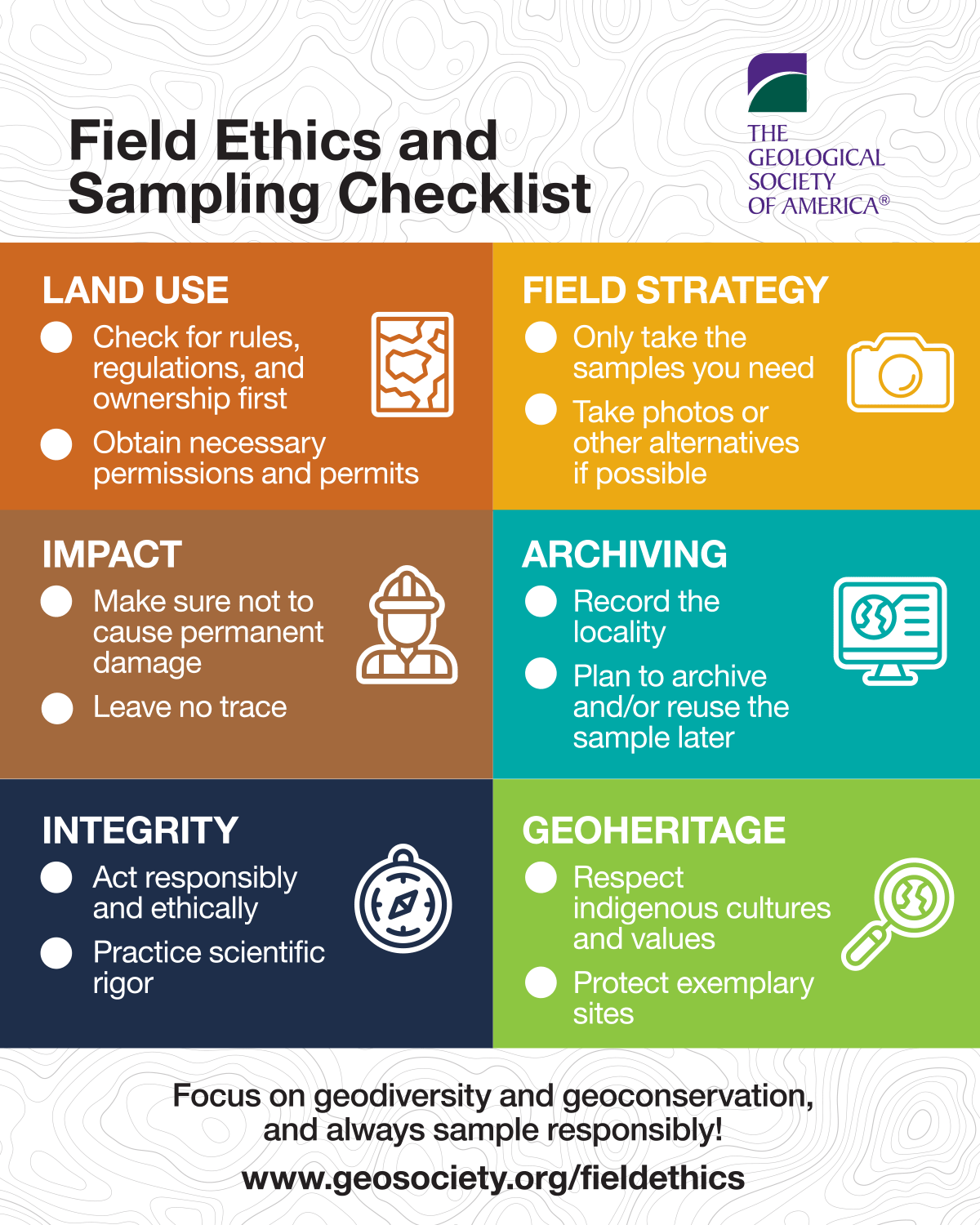
Be sure to check out the Field Ethics and Sampling Checklist and the GSA Today article "Establishing an ethic of sampling for future generations of geoscientists" that gives more details:

Good luck!

Tuesday, April 12, 2022

Professional Geologist licensure in California

I want to broadly summarize the requirements for licensure as a Professional Geologist in the state of California so that undergraduate and graduate students have a better understanding when making decisions about taking a geology field camp course and to gain the necessary 5 years of work experience under the supervision of a Professional Geologist or Geophysicist. You can also check out this video of a seminar by Laurie Racca (Senior Registrar, Geology & Geophysics, Board for Professional Engineers, Land Surveyors, and Geologists) discussing "Understanding Professional Geology License Requirements: California 2019" on YouTube.

Geologist-in-Training (GIT) certificationan optional step prior to PG licensure: If you think you may want to become a Professional Geologist in the future, we recommend you the take National Association of State Boards of Geology (ASBOG) Fundamentals of Geology (FG) exam ($75 in 2022) ASAP after graduating from your undergraduate institution so that your geology coursework is fresh in your mind. The ASBOG FG exam is the only exam you can take prior to completing your work experience. After you meet the educational requirements (which includes the 5 semester units of upper division field geology instruction) for the Geologist-in-Training (GIT) certification and pass the FG exam, you can apply for a GIT certificate which are the first steps to becoming licensed as a Professional Geologist in California. The GIT certificate shows that the holder has passed the FG exam and met certain educational requirements, which are the first steps to becoming licensed as a PG – the GIT certificate may help you to qualify for your entry-level work experiences under a licensed Professional Geologist or Geophysicist. You may apply for the PG license without having a GIT certificate or having already passed the FG exam.

A Professional Geologist license is the formal permission from the State of California –required by law – to practice geology for others in California. To qualify for PG licensure, you need to 1) meet the educational requirements (e.g., a BS degree in Geology, or 30 semester units of geology coursework [24 units must be upper division or graduate-level]) including 5 semester units of field geology instruction; 2) have a documented record of a minimum of 5 years of professional geological experience by working under the supervision of a geologist or geophysicist licensed in California or any other state; and 3) pass the PG exam ($175 in 2022).

You can get credit toward this 5-year work experience requirement – up to a maximum of 3 years' credit – in a few ways:

1) Each year of undergraduate study in the geological sciences shall count as one-half year of training, up to a maximum of 2 years;

2) Each year of graduate study or research counts as a year of training.

3) Teaching in the geological sciences at the college level is credited year for year (the total teaching experience must include six semester units per semester, or equivalent if on the quarter system, of upper division or graduate courses).

You submit official transcripts and 3 reference letters that describe your professional work experience along with the application for licensure as a Professional Geologist.

Good luck!

Thursday, September 16, 2021

Find a geology field camp that's right for you

Before you apply to a geology field camp, be sure to speak to an academic advisor in your program to ensure your choice of field camp will meet your degree program requirements. Summer field camps usually consist of 4 to 6 weeks (equivalent to 4 to 6 semester units) of intensive field coursework, which allows students the opportunity to apply and integrate the knowledge and skills obtained in their undergraduate courses and prepares them further for work as a professional geologist and/or graduate studies.*

Future Professional Geologist certification considerations

Summer field camp also ensures that graduating geology students have met the appropriate coursework requirements to secure future professional licensure. To qualify to take the Fundamentals of Geology (FG) and Professional Geologist (PG) exams in California requires a minimum of 5 semester units of upper division field instruction in geology as part of your coursework. PG licensure may be required by employers for positions in the consulting industry (e.g., environmental or geotechnical work), so taking summer field geology will make you more employable in the environmental and geotechnical consulting industry. You can qualify for entry-level positions with the Geologist-in-Training certificate from California and/or by passing the FG exam.

Most geology field camps are in the northern hemisphere and take place over the summer with starting dates in May through August. There are a few field camps (e.g., in New Zealand) that take place over the winter – the timing of these field camps may help you to finish your degree requirements earlier (i.e., so that you don't have to wait for a summer field camp course).

Geology Field Camps

– Geology.com's Geology Field Camps - A Comprehensive Listing (mixture of U.S.-based and international field camps)

*NAGT's list of 2021 Field Camps: Virtual, In-Person, and Hybrid

– NAGT's Field Course Collection

South Dakota School of Mines & Technology Field Camps (in the U.S. and abroad)

San José State University's Geology Field Camp is a great choice for SF Bay Area students. The Sacramento State Field Camp and the University of Nevada Reno Summer Field Camp also accept applications from students at other universities.

Alternative Summer Field Courses

Here are some alternatives to the traditional geology field camp courses (these are just examples – there are many others):

Field Camp Costs

Refer to this American Geosciences Institute study of the "Median costs of field camp attendance at US-based institutions." Here's what it boils down to: "The median cost to attend field camp at all US-based institutions as an in-state student is $3,850, wtih overall costs ranging from a minimum of $1,550 to a maximum of $7,425." The cost varies considerably depending on several factors including: 1) the length of the field course (3, 4, 5, or 6 weeks), 2) whether there is travel involved (our majors have completed geology field camps in Hawaii, Iceland, Turkey, Morocco, France, etc.), 3) the type of accommodation varies widely from low-cost tent camping to higher end cabins or lodges that include kitchen facilities and indoor plumbing, and 4) students may also be required to pay out-of-state tuition if the field camp is offered through a university based outside of California. I will reiterate that a 3- or 4-week field geology course (therefore 3 or 4 semester units) meets part of the graduation requirements for our Geology BS program at SF State, but a 5- or 6-week field camp course (equal to a minimum of 5 semester units) is required for certification as a Professional Geologist in California. Note that it is possible to sum together the total upper division field instruction you have had to achieve this minimum 5 units – for example, you might be able to apply a 2-unit upper division Field Methods course and a 4-unit field camp course to meet this requirement.

Choosing a Field Camp & What to Expect

Field Camp: An Introduction & Personal Experiences by Adriane Lam of the Time Scavengers blog

Why Should I Study Geology in the Field? by Lee J. Suttner, Department of Geological Sciences, Indiana University

– Advice on How to Choose a Field Camp by David Rodgers, former Geology Field Camp Director, Idaho State University

– What to Expect at Geology Field Camp, by Emily & Eric Ferré, Department of Geology, Southern Illinois University 

– Essay about field camp – Mind, Body, and Spirit – by Jade Bowers

Saturday, October 3, 2020

So you want to be a mineralogist...

As a new undergraduate geology major, you’re just getting started, and you need more coursework under your belt before you start to better understand your interests and decide on the next steps to your future career. Working toward a traditional geology BS degree is a great way to go. You will learn a lot of different skills that make you employable in many different industries. The geology BS gives you the credentials to do a lot of different jobs after graduation at an introductory level or to prepare you for graduate research. Some careers may take additional training (i.e., graduate school) when you start to specialize.


Here’s a list that I put together (with the help of a little Googling):
• Biomineralogy (a whole new field that has opened up)
• Microscopy - asbestos remediation (or other specialization) or asbestos in talc litigation using TEM (transmission electron microscopy), SEM (scanning electron microscope), EDS (energy dispersive spectroscopy), PLM (Polarized Light Microscopy), PCM (Phase Contrast Microscopy)
• Manage an electron microprobe or SEM lab
• Federal and State agencies - USGS, California Geological Survey, CalTrans, SLAC, LANL, LBNL, NASA, EPA, OSHA
• Materials Science/metallurgy - engineering applications, materials manufacturing and testing facility
• Gemology*
• X-ray diffraction analysis
• Natural History museum curation or similar
• Community College instructor - this is an especially transportable degree - there are CCs everywhere
• Medical mineralogy
• Forensic geology/mineralogy
• Ceramic manufacturing or concrete production
• Civil and geological engineering
• Rare earth element exploration (used in electric/hybrid car batteries) including carbonatite research 
• Planetary geology
• Remote sensing and satellite imagery
• Planetary geology using remote sensing or rover data
• Geographic Information Systems (GIS)
• Metallurgy
• Analytical chemistry
• Professional Geologist**
• Thin section and geological sample preparation

I encourage you to explore any of these more online. There may be courses in other University departments like Chemistry, Engineering, Computer Sciences, Geography, or Physics that you can take as elective courses and that can help train you for these careers. Some of these careers might also require a Masters degree to advance fully.

* Additional professional education required – here is an example of one such school at the Gemological Institute of America 
** Exam(s) required in each state in which you want to practice as a PG to qualify. Here is some info on the GIT and PG exams in California.

Saturday, September 20, 2014

Potential dangers of working in the field

A couple of recent articles have pointed to potential dangers of sexual harassment or assault during scientific field work. I can't say that I'm surprised at the numbers. When you're working in a strange environment, a foreign country, in close quarters, adverse conditions, etc., the possibility of harassment or assault is increased. I am linking to the articles here to share with you. You have to be smart to protect yourself when you're in the field in many different ways.

Here is the New York Times opinion piece by Hope Jahren (University of Hawaii) about her experience in the field, including a warning to women in the field sciences, and hope that men will learn about this problem too.

This is the PLoS One article by Clancy et al. (2014) that is referenced in the NY Times article.

January 2019 update: The stories of harassment of women in the field continue. Read this compelling story of a Boston University professor and his graduate student in the field in Antarctica in Science.


Thursday, February 20, 2014

Managing and spending grant funds

Are you a student wondering why your advisor can or can't spend grant funds on you? Read this post from Prof-like Substance...

Sunday, January 19, 2014

Go to grad school with your eyes open!


Stipends in grad school are.... modest (see above) and don't allow the kind of lifestyle that you can maintain with a "real" job. You're still a trainee in grad school, hence all of the comics pertaining to eating ramen noodles and the obsession with free food in PhD Comics, and other blogs about grad school... (and if you didn't think you could live on this kind of stipend [barring personal or family emergencies], why did you sign up for this?)

This past week, the Professor Is In blog began a survey of PhD debt to assess whether reports she'd heard about credit card and loan debt in the 100s of thousands of dollars could be real (i.e., >$260,000 in debt for a philosophy degree). Slate Magazine, The Atlantic, and The Chronicle of Higher Education all have articles about this survey too. You can go to the results of this survey through the above link, but here's a 2012 summary from a similar NSF survey:


Over 60% of the respondents reported zero debt, but nearly a quarter reported debt over $30,000. You can enter numbers for your own grad school experience at the Professor Is In blog. Post-grad school debt is much less of a problem for students in the physical sciences and engineering probably because most of those students are offered both a stipend and full tuition when they're admitted, and because those students spend only ~5 years on average in grad school.


As an undergraduate, I went to a local state university and my parents paid for my tuition. As a graduate student at a big research university, I was single and childless, drove a 15-year-old car, shared an apartment in a less expensive neighborhood that was a bit of a drive from campus, ate a lot of pasta, and didn't eat out much. I had a teaching assistantship for $12,000 (for 9 months) and my tuition was covered by the university. I graduated with $0 debt and had a blast in grad school (and I never took a loan, never had any credit card debt, and never worked another job apart from being a grad student). So zero debt is absolutely possible.... you just have to live like a student.


I really don't understand students that complain about being broke yet buy lunch out daily, drink Perrier instead of drinking out of the free water cooler that the department keeps, buy organic berries from Whole Foods (aka "whole paycheck"), get regular facials, or drive a new car. These examples are based on real people and they are what I consider pretty outrageous choices for someone in school.  If you're in grad school in the physical sciences and you're accumulating serious debt, you're making some seriously poor lifestyle choices, or you made some bad decisions en route to grad school (perhaps a you got a philosophy/religion/english degree at an expensive, small liberal arts college back east and piled up debt?). As a grad student, you're still a trainee (you don't have a degree yet!) and can't expect the same standard of living that your roommate(s) who got a job at Google straight out of college might have. But consider, your roommates may make a whole lot more than a typical grad student, but they have regular work hours, might have a dress code, get only two weeks of vacation per year (and can't leave for an awesome backpacking trip to Chile for 3 weeks at the drop of a hat [without getting fired]), and have to regularly meet deadlines (with complete, quality work...gasp!).

If you're thinking about grad school, go read the "Why did you take out the loans" comments in the PhD debt survey, think about what living like a grad student means, and consider if grad school is right for you before diving in...

Friday, August 9, 2013

(Lack of) Recognition for women in science

In looking for information about the 2013 American Geophysical Union meeting in San Francisco that my students and I attend each year, I ran across this photo of the 2012 Honors Ceremony to recognize scientists that have made significant contributions to the earth sciences:


I count about 23 medals hanging around necks in the first two rows of seats, and there is exactly one woman. (Did the photographer put her in the front row to make sure we see her?) I think this is appalling.

The reasons for such a small percentage of women being recognized for their contributions to earth science probably reflect in part why the numbers of women in STEM (science, technology, engineering, and mathematics) disciplines steadily decreases from the students graduate from university through the rank of full professor and beyond:


I don't want to re-hash the various arguments about why women don't stay in STEM fields in academia - they range from "old boys club" sexism in hiring and a hostile work environment to wanting to have kids while trying to earn tenure to wanting higher salaries for less work required outside academia to a lack of support from their spouses at home to dual career couples who can't make it work - but rather to point out that whatever the reason(s), women remain underrepresented in STEM fields and that needs to be corrected.


Sunday, April 28, 2013

What can you do with a degree in Geology?

In 2012, Forbes magazine listed Geology as the 7th most valuable college major with a starting median salary of $45,300, and a mid-career median salary of $83,300. Many positions have much higher starting salaries depending on the field, for example, mining and petroleum industry positions: petroleum engineers have median earnings of $120,000. A recent study from Georgetown University noted that there is virtually no unemployment in the field of geological and geophysical engineering. Most geologists are employed in the western U.S., and in the south-central U.S. (Texas and Oklahoma) where jobs in the petroleum industry dominate. A recent American Geosciences Institute workforce evaluation estimates that by 2021, some 150,000 to 220,000 geoscience jobs will need to be filled. The AGI report notes that at current graduation rates, most of these jobs will not be able to be filled by U.S. citizens.

20+ Geoscience Careers & How Much Geoscientists Make

Graduates in geology may pursue a wide range of careers in the earth sciences and related fields:

• Environmental and Geotechnical consulting firms
• Energy companies such as petroleum exploration firms
• Mining companies and critical mineral resources
• Greenhouse gas sequestration
• Government agencies such as the U.S. Geologic Survey, Environmental Protection Agency, National Park Service, California State Parks, Department of the Interior, Bureau of Land Management
• State/local agencies such as the California Geological Survey, Caltrans, Water-Quality Control Board, San Francisco Public Utilities Commission, city planning offices, state and federal highway departments
• Non-profit organizations that work to study and protect environmental quality
• Engineering geology to oversee the planning and construction of buildings, bridges, roads, dams, landfills, and tunnels
• Informal educational institutions such as museums
• Technician for science departments in universities or other institutions
• Teach science at the middle & high school levels
• Teach Earth and environmental science at community college (MS degree often required)
• University professorship teaching and conducting research (requires PhD)
• Science writing for online and print media
• Environmental law
• Publishers and producers of science books, magazines, computer software, web material, television shows
• Asbestos consulting and testing labs & asbestos remediation
• Professional Geologist, Certified Hydrogeologist, and/or Certified Engineering Geologist
• Natural hazards like earthquake seismology and volcanology
• Groundwater resources & modeling
• and many more careers that take advantage of the skills you've gained during your education

Wednesday, February 29, 2012

The GRE (with a 2020 update)

GRE scores are required with most applications to graduate school. You must (MUST!) study for the GRE because you can improve your quantitative score dramatically even if your math skills are good (even very good), and the quantitative scores are what science faculty look at first. And despite the GRE's shortcomings, the majority of faculty looking at graduate applications give the scores A LOT of weight. The verbal scores are frankly less important (to me and some other faculty, even at large research universities) because it better reflects an applicant's economic background (and, of course, whether an applicant is a native English speaker), and tells us nothing about your ability to write. If I want to know if an applicant can write (and if they're savvy), I look to their e-mails to me and to their statement of purpose.

October 2020 update: There is no statistical correlation between GRE scores and success in graduate school. According to this article in The Atlantic, student performance on the GRE correlates more closely to a combination of factors that includes access to expensive test prep courses and other educational opportunities that prepare students for the test, and even the "student’s own insecurities regarding race and gender." A UCSF study showed that success in graduate school is better predicted by letters of recommendation from faculty advisors who know the student well, and the amount of research experience the applicant already has under their belt.

The Earth & Climate Sciences Department at SF State has joined the growing ranks of geology/Earth science departments that have ended the practice of requiring GRE scores be submitted with grad school applications. Many universities have ended this requirement; some make reporting your GRE scores optional which makes the choice of whether or not to report your scores a new kind of problem (I advise against it unless your scores are top tier). It is not yet universal, but the number of programs adopting this new policy is growing particularly following the impacts of the Covid-19 pandemic. Of course, letters of recommendation aren't a perfect means of evaluation. A 2016 study in Nature Geoscience showed that women are "significantly less likely to receive excellent recommendation letters than their male counterparts" and the length of letters written for women are much shorter.

There is no easy fix here. Faculty in the Earth & Climate Sciences Department at SF State have started to use evaluation rubrics for hiring new faculty to avoid implicit bias. I think it's time to start using a similar rubric to evaluate graduate program applicants... and without a column for GRE scores!

Tuesday, November 2, 2010

The Statement of Purpose

Graduate program applications generally require you submit a generic application form of some sort, your university transcript(s), GRE scores*, a CV, letters of reference (these should go directly from the letter writer to the university), and a statement of purpose. The SOP is important both for its content and for how well you express yourself.

In general, your statement of purpose (SOP) is a 1-2 page typed description that addresses three areas: (1) Your educational experiences and how they have led to your interest in graduate study in the geological sciences; (2) a description of any scientific research you have conducted (be specific and include field experience, lab/analytical work, a summary of your findings); and (3) a description of your research interests for graduate school and your career goals. A well-crafted statement of purpose is specific about what you want to study and the geology faculty member(s) you are interested in working with. Do your research about the faculty and department to which you are applying and tailor each of your SOPs to that faculty member/department. You do not need to know exactly which one faculty member you want to work with - it's OK to include two or three names (maximum) if they are working in related/complementary fields (but don't include, for example, a geophysicist, a geomorphologist, and a hydrologist - that would demonstrate that you have no idea what you want...). Nor do you need to know exactly which project you want to work on - be as specific as possible about your interests ("extensional terranes", "metamorphic core complexes", "ultrahigh-pressure metamorphism") and certainly include a description of how your research experience has prepared you to tackle your proposed research. Look through the websites of potential graduate advisors to see which projects are active. You can also search the National Science Foundation website to look for active research grants for those prospective advisors (although not all research funding comes through the NSF, that is a major source of funding in the Earth sciences).

This web site and this link have good descriptions of the basics of the SOP (even though these are intended for graduate programs in psychology) and some things to avoid. Whatever you do, don't start your SOP off with the all-too-common "I have loved geology since I was just a kid starting out with my first rock collection" sort of statement. Gag me. Just start with your college experience, or perhaps one notable trip you took where you learned about geology. Be matter of fact, as specific as possible, concise, and use the SOP as a place to elaborate on things only briefly included in your CV (like your research experience) or to discuss things that don't appear elsewhere in your application and that are relevant to your application (e.g., if you need to explain poor GRE scores or a D in a chemistry class in your freshman year). Stay positive and don't make excuses.

Spell check, proofread, and have someone else read your statement and give you feedback before submitting it (a grad student, a faculty advisor, swap SOPs with other students). The rest of your academic record can't be changed at this stage, and you can't control what your letter writers say, but you CAN write an excellent SOP.

*GRE scores are no longer required to apply to the MS program in Geosciences at SF State.

The CV

You need a basic CV as you progress through your career as a scientist: to apply for fellowships and grants, graduate school, internships, etc. Read through this thorough description of a basic science CV by Richard Reis in The Chronicle of Higher Education and see several resources on How to Craft a Winning Résumé on the Science Careers (AAAS) web site. Once you have all your basic info down, you should take particular care to 1) proofread your CV for typos, 2) make sure it is formatted simply so that it is easy to find critical information (e.g., year(s) of your degree(s)), 3) avoid excessive wordiness (less is more - don't use complete sentences to describe your skills, instead use bullets), and 4) keep it to a maximum of 1 or 2 pages unless you already have a PhD and can justify a longer CV (i.e., have you used an 11 pt. font, played with the page margins and spacing? Have you already removed all items related to your high school record? hobbies? and anything else that isn't DIRECTLY related to your career as a scientist?). In early versions of your CV, err on the side of INCLUDING small awards or presentations (a scholarship from the local gem and mineral society, a poster competition in your College of Science, etc.). Include other languages you speak, specialized lab techniques you have experience with, specialized software you use (no, we don't want to see that you've mastered MS Word).

Things that SHOULD NOT be included in your CV: a photo of yourself, your birth date or age, your marital status, an exhaustive list of your college courses, your hobbies (unless you happen to have an Olympic medal or some other very notable "hobby" that will make your CV stand out but perhaps work that into your Honors and Awards section).

Finally, look at CVs of other academics for formatting ideas and ideas for what to include in your CV. I happen to like the way my CV is formatted (I don't overuse bullets, but instead use more bold type, italics, underlining, and creative spacing to make the information easy to find. You should include the dollar amounts of any awards/scholarships in your CV). Then have someone (an advisor or graduate student) look at your draft CV before you send it off. Send your CV as a .pdf file and not an MS Word file to avoid software problems.

Before you submit an application for a PhD program....

After you take the GRE* and after you've chosen a few graduate programs to apply to (see my previous posts here and here), you should take a few steps to make the initial contact with potential future graduate advisors. First, do your research about the faculty member online and maybe read a recent paper or two of theirs. Then draft a professional e-mail to introduce yourself and enquire whether a faculty member anticipates taking any new graduate students for the next academic year. A generic e-mail (from your university e-mail account) might read like this: Dear Prof. X, My name is Jane Doe and I will complete my B.S. in Geology at San Francisco State University in May 2011. I hope to begin PhD research next fall and I am very interested in your research on Interesting Topic Y that I read about in your X et al. (2010) paper in Important Journal of Research. I completed a research project on A and B with Prof. Z at SF State and believe I am well-prepared to start research on Interesting Topic Y at Prestigious University. Do you anticipate taking any new PhD students next fall? I would like to discuss any opportunities you might have to join your research group. I see that you have a poster with Unknown Person [the first author on the poster that you're referring to] on Wednesday morning of the AGU meeting in San Francisco - if you plan to be at the poster that Wednesday morning, may we schedule a time to meet briefly? I am attaching my CV for your reference. Many thanks for your consideration. Best Regards, Humble Student Because the process of applying to graduate programs starts in the fall term, you have two opportunities to make further contact with potential graduate advisors (particularly if their university is too distant to justify a road trip for a casual visit): at the Annual Meeting of the Geological Society of America meeting (in October or November) and the Fall Meeting of the American Geophysical Union (in December). For my students who always attend the AGU meeting in San Francisco, I recommend checking to see if the faculty member is presenting a talk or poster at which you might introduce yourself, hear about their research, and ask intelligent questions: Search the Fall Meeting program for their last name. If you get zero search results back, you can still ask whether they will be at the AGU meeting in San Francisco, and might be able to meet - they might be planning on being a "conference tourist" (i.e., attending but not presenting) or, if not, you get bonus points by showing that you will attend that meeting. You should certainly invite a potential advisor to visit your poster if you're presenting one - be sure to include the details of your poster (i.e., T32E-47) and when you plan to be at your poster (your poster stays up all day, but you will only likely be present for 2-4 hours). If you are an M.S. student writing this e-mail, you should include a few more details about your interest in the faculty member's research and certainly more details about your research experience (tailor it to the specific faculty member: field work, lab/analytical techniques, a one-liner about the preliminary results of your research). Then proofread your e-mail: Fix typos, check the spelling of the faculty member's name, etc. I would add a "signature" at the bottom of your e-mail that has your name and contact information (kind of like a business card): Jane Doe M.S. Candidate Department of Geosciences San Francisco State University 1600 Holloway Avenue San Francisco, CA 94132 Tel: 415-555-5555 (cell phone is OK) Fax: 415-555-5556 E-mail: jdoe@sfsu.edu Home page: http://online.sfsu.edu/~jdoe If you are going to send several of these e-mails, MAKE ABSOLUTELY SURE that you have used the correct name of the faculty member, the correct topic of their research that interests you, and the correct name of their university before clicking 'Send'. It's very easy to change the Dear Prof. X part, and forget to make similar changes to the body of the e-mail. Don't embarass yourself. Then, depending on the response you get, you plan your meeting with him/her at AGU (dress nicely [smart casual, no tie needed], bring a copy of your CV, read the abstract of their poster/talk in advance, etc.), or you reply "Thank you very much! I plan to submit my application to Prestigious University in the next few weeks. Regards, Humble Student". If they say 'no thanks', still take the time to thank them for their response. Whatever you write back, don't just reply "thx", but format your e-mail professionally similar to the first. The whole point of this is to introduce yourself to a potential future PhD advisor so that your application stands out from the rest (or so that you don't waste time and money applying) and so that they remember communicating with you, or meeting you, in a positive light.

*GRE scores are no longer required in applications to the graduate program in Earth & Climate Sciences

Friday, July 30, 2010

Choosing a PhD advisor

A recent blog thread prompted me to read an article by Bruce Alberts, Editor-in-Chief of Science "On Becoming a Scientist" and post some thought on choosing a PhD advisor here.

He starts: “The exact project pursued for a Ph.D. degree is not nearly as important as finding the best place for learning how to push forward the frontier of knowledge as an independent investigator.” How true. Some advice summarized from the article:

1) Choose a research group led by a person with high scientific and ethical standards. Have they published frequently and in prestigious journals? Do they have NSF-supported research projects? Search for their name on the NSF awards web site;

2) Find an advisor who will pay close attention to your development as a scientist (a small research group is perhaps better than a large group in which your interests can get lost). Talk to current students in that group and discover whether they have had conversations with their advisor about their future career. Have they been encouraged to present their research at conferences, write papers and grant proposals? Are there multiple faculty doing research in related fields? That could create a supportive community of faculty and grad students in which you might thrive. Are there regular departmental seminars on topics of interest to you by visiting scientists? Does the research group meet regularly to discuss research progress, etc.? The upshot: is there a community that will provide an intellectually-stimulating and supportive environment?;

3) Choose an advisor that will provide you with enough guidance to prevent you from wasting time on nonproductive pursuits, while giving you the freedom to innovate and learn from your own mistakes. How hands-on or hands-off is s/he as an advisor? Is there a chance that you might become enslaved as the mass spec repair dude during your PhD or will you get lots of hands-on experience in the lab while you're doing your research and walk away 5 years later with important skills;

4) Choose your research project well (this is a tricky one as it's hard to see the forest for the trees when you're fresh out of your undergraduate studies): “ambitious enough to be important and exciting, innovative enough to make unique contributions likely, and nevertheless have a good chance of producing valuable results”. Have this conversation with your advisor when you're choosing your project.

5) The choice of a postdoctoral research group is the place to establish yourself with your long-term career in mind – you should choose a lab where you can acquire skills that complement those you already have.

6) Finally, I'll add that you should consider whether the faculty member is near retirement or whether they are just starting to grow their research program (what year did they get their PhD and do some math) - are they actively doing exciting research? have they published recently? do they have active grants through NSF? Some mid- or late-career faculty might drift into administrative roles that take them away from their research. Very new/young faculty might be sinking all of their time into starting up a new lab or teaching brand new courses and not have much time for advising, they might not have external grant funding yet to support their research, or their research groups might be nonexistent or very small (perhaps not the most supportive environment). At the same time, very new/young faculty might feel more energized by their research and still have a fire in their belly that could lead you down exciting research roads (at the very least, if they are pre-tenure [Assistant Professors in their first 6 years of their positions] they will still have to work very hard to be productive...).

There is an awful lot of luck, knowing the right people, and being in the right place at the right time in becoming a successful scientist. You can control who you know - your research mentors. Choose well.

Friday, May 28, 2010

Applying to PhD programs, part I

Thinking about applying to a PhD program? There is more to consider than just the interesting research being done at a given university. A successful PhD requires:

1) A great research problem - you're going to be working on and thinking about this research for (probably) 5 years. Do your research online and see which universities have geology departments with faculty doing research in your field of interest...is it one faculty member or several? do they have laboratory/analytical facilities to carry out some of this research?;

2) A graduate advisor you can work with for 5 years - are your expectations for how hands-on or hands-off you want your research advisor to be in line with their advising style? Do your personalities mesh? Talk to a potential advisor's students to get a better understanding...;

3) A place you'd like to live. This goes beyond just geography - yes, it does matter whether the university is in an urban or rural setting, on the east or west coast, or whether it's hot and muggy in the summer or covered in snow in the winter (which do you prefer?), but consider the culture in the department you're applying to (is there a big group of students working on similar problems to yours that you might be able to look to for support? do you like them? are people in the department friendly? are doors wide open in the hallways? are there frequent seminars with interesting outside speakers?);

4) Money. No not just the stipend you're likely to be offered. Money to actually get the research done. You can live on Ramen noodles, but you can't get field work and lab work done without research funding. You can ask a potential advisor about this if you are invited to visit campus, but you can also do a little homework to find out if the advisor has any active grants with the National Science Foundation or at least whether they have a history of grant funding.

Don't get your mind set on one or two grad schools you think you'd like...do some searching on the web to see which universities have faculty working on projects that interest you and try to keep an open mind - A big name university might not be the best fit for you (and no, I'm not suggesting you couldn't get in...).

Look for Part II when I'll give advice on how to approach a potential graduate advisor with things to do before, during, and after actually sending in your application.

Also, continue to consider whether graduate school is right for you - research requires a very different set of skills than taking college courses and it's not a good fit for everyone...

Field camp is a really good thing

Field camp has become less commonly required for geology majors in the last ~10 years. That's a bad thing. In our department, we offer students a choice of either completing a field camp course with another university or completing a research project as part of a senior thesis. I believe most undergraduate geology students should take field camp, and that the undergraduate education in geology is incomplete without it. Field camp is excellent preparation for graduate school, for geotechnical jobs that require field experience, and a minimum of 5 semester units is required to qualify for the exams to become a Professional Geologist in California. Here are lists of over 100 field courses and field camps offered across North America and a few outside the US (even a couple in the southern hemisphere for those who want a winter field camp between November and February). Students in our department have attended – and gave rave reviews on – several of the field camps given through the South Dakota School of Mines & Techonology (specifically Hawaii, Montana, Iceland, Turkey, Morocco & France). 

Choosing a field camp & what to expect
This post has links to articles giving advice on how to choose a field camp and articles discussing what to expect at field camp. When choosing a field camp at another institution, consider finding a group of friends that might want to go with you so that you can apply together. That way, when you're starting out you already know at least a few people. However, one of the comments I hear frequently from students on their return is how great it was to meet students from so many different places. 

Field camp isn't cheap
Please see this post that points you to a few resources that might help. You can reduce the cost by 1) attending field camp at your home institution so that you don't have to cover the cost of tuition at another university; 2) attend a field camp close to home to reduce the amount of travel needed to simply get to the field camp site; 3) attend a field camp in which you're actually expected to camp in tents (many offer cabins or other accommodations that increase the total cost); or 4) choose a field camp in a location that you can find cheap air tickets to/from.


Saturday, November 28, 2009

Piled Higher and Deeper


Grad school getting you down? Is your advisor too demanding? Do you need to seek solace in others who share your situation? Check out Piled Higher and Deeper, a grad student comic strip.

Wednesday, November 18, 2009

Mentor-mentee relationships

I just spotted this blog on Sciencewomen that discusses the job of a mentor and being a mentee. I like this passage, paraphrased from a talk SciWo attended, in particular:

"Dr. Cassell also talked about the characteristics of a good mentor, qualities that included accessibility, empathy, honesty, savvy, humility (most important), consistency, open-mindedness, and understanding of the current/new research/academic/professional environment. Mentors should be providing networking opportunities, offering moral support, and encouraging creative thinking. In turn, good mentees are proactive, probing, gracious, and humble in accepting critical feedback.

Of course, you are not going to meet all of your mentoring needs in a single relationship, so Cassell suggests to never let go of old mentors, establish both official and informal mentors and also find a set of confidants. She urges mentees to keep meetings professional."

I'll let that speak for itself.